Make it personal
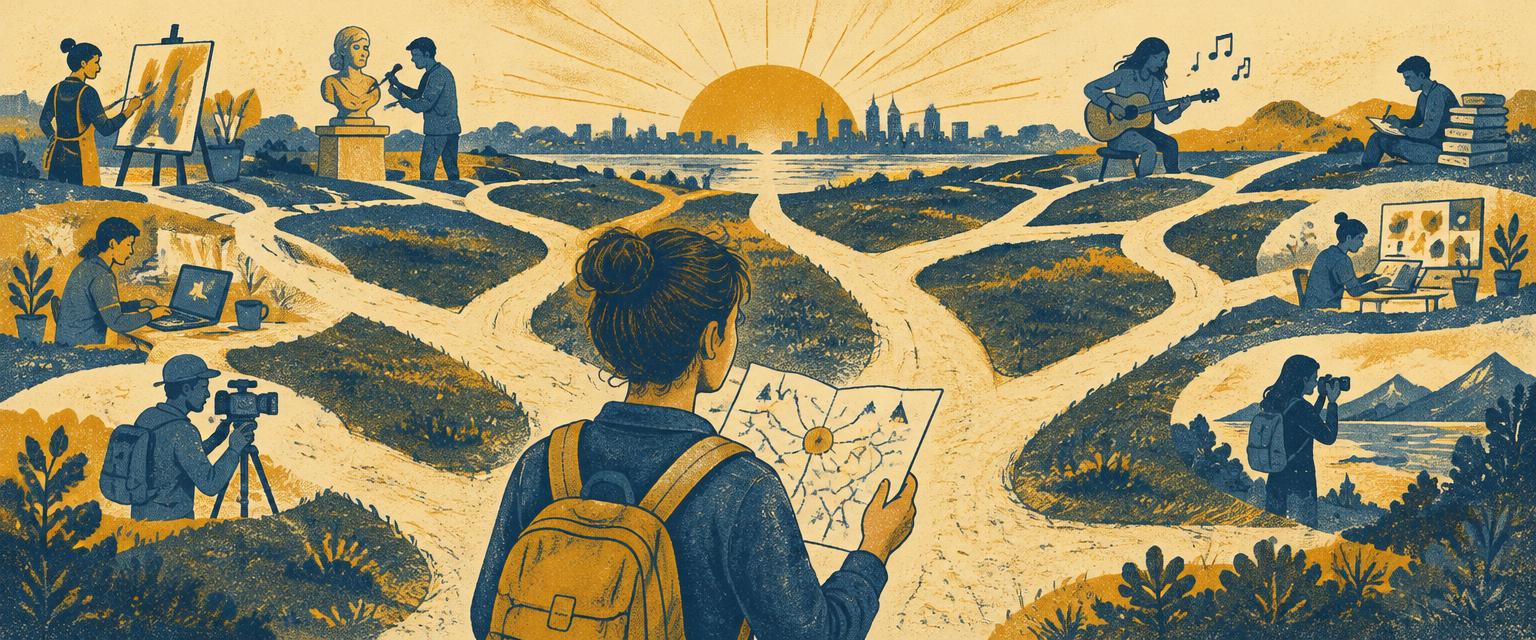
In plain termsThis is where general trends become your plan. Use the prompts below with your real major and interests, then treat the answers as a starting point for a conversation with an advisor, a professor, or career services — not as the final word.
Six prompts to find out what this means for you
Paste into ChatGPT, Claude, or Gemini. Fill in the [brackets]. Then argue with the answer.
Ask a hiring manager from 2030
Act as a hiring manager in [your field] in 2030. Using the WEF Future of Jobs Report 2025, tell me: what would make you hire a new grad over AI? Give me 5 skills and 3 projects to show you. Label what is data and what is your guess.
You’ll learn: What to build before you graduate.
1 · Map my skills
I'm a [year] [major] at [school]. AI makes intelligence abundant, so taste and agency matter most. Which tasks will AI absorb, which stay human, and which 3 skills should I build first?
You’ll learn: Where you’re exposed and strong.
2 · Read the job market
Using the WEF Future of Jobs Report 2025, how are jobs in [field] changing? Name 5 rising roles, 3 declining, the key skills, and your doubts. Cite sources.
You’ll learn: Your field’s trajectory, with sources.
3 · Find my idea
Interview me one question at a time to find a problem I know firsthand. Then guide me through Notice, Picture, Prototype with AI, Judge, and a one-page project brief.
You’ll learn: A project worth building.
4 · Test my taste
Here is my work: [paste]. Act as a tough, kind editor. Where is the gap between my taste and my output? Give 3 fixes and 5 practice reps.
You’ll learn: How to close the Ira Glass gap.
5 · Plan my 30 days
Act as my chief of staff. I have [X] hours a week. Plan 30 days to build AI fluency and one real project. Say what to delegate to AI and what I must check.
You’ll learn: Your first month as a checklist.
How to get a good answer
- Add your goal, audience, and limits (Concise, Logical, Explicit).
- Ask for sources and uncertainty.
- Don’t paste private data.
- Check your class’s AI policy.
- Ask: What would change your answer?
- The answer is a draft. Your judgment is the product.
Sources: WEF, Future of Jobs Report 2025.
In plain termsThe tools are already here, and they keep improving. What sets people apart is clarity about what they want to make, the judgment to tell good from bad, and the willingness to start. AI literacy is knowing how to use these tools well — and when not to.
Everyone is a builder now.
The tools exist. The intelligence is abundant. The only thing between you and something remarkable is the clarity of your vision and the courage to pursue it.
- What do you want to bring into the world?
- What is uniquely yours about your vision for it?
- How do you make something so good the world can’t ignore you?
- The Imagination Age is here. What will you build?
Check your understanding
Sign in to save your quiz results and earn your certificate.