OpenAI
ChatGPT
Where AI is heading, what the labs are building, three futures you could live in, and how to prepare for more than one.
Four major 2025–2026 studies surveyed more than 85,000 students in 35 countries. The question is no longer whether students use AI, but whether colleges are keeping up.
ChatGPT
Claude
Gemini
Meta AI
Grok
Amazon Nova
Copilot
Takeaway: You are part of the majority figuring this out in real time. Learning to use AI well is now a normal part of college.
Sources: Lumina Foundation–Gallup State of Higher Education 2026; Digital Education Council Global AI Survey 2026; AlinHE.org 2026; Handshake Class of 2026 Workforce Outlook.
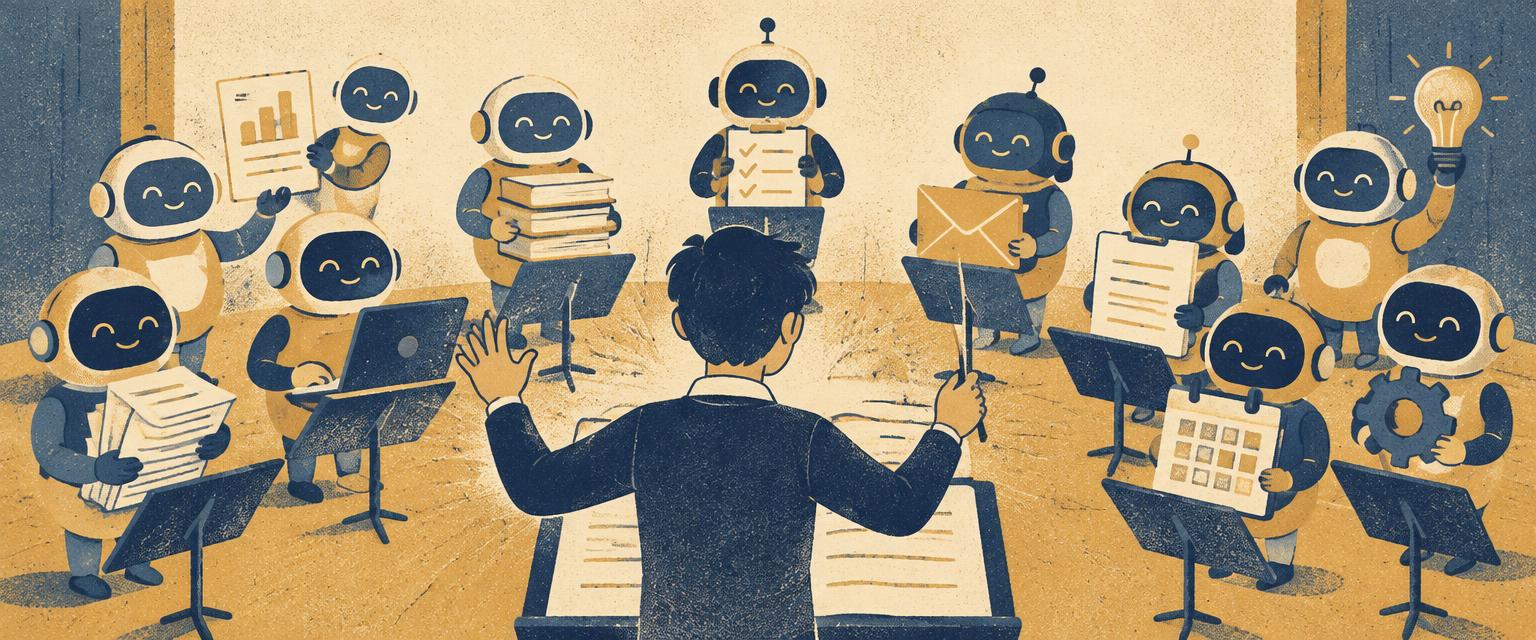
A chatbot tells you how to cook dinner. An agent orders the groceries, preheats the oven, and sets a timer. Agents plan, use tools, and take steps on their own.
Always-on agents that work in the background.
Handles files, Microsoft 365, and full software projects.
Browses with your logins and manages Workspace tasks.
Sends email, books travel, and launches helper agents via WhatsApp.
METR (Model Evaluation and Threat Research) is an independent group that tests frontier models before release. It tracks the “time horizon”: the longest task, in human-expert time, an agent finishes half the time. It has doubled about every 7 months since 2019.
Takeaway: Longer time horizons mean agents can handle bigger chunks of real work, which makes your direction and review more important.
Sources: METR time-horizon reports (2025–2026). METR cautions against precise comparisons at the top of its range.
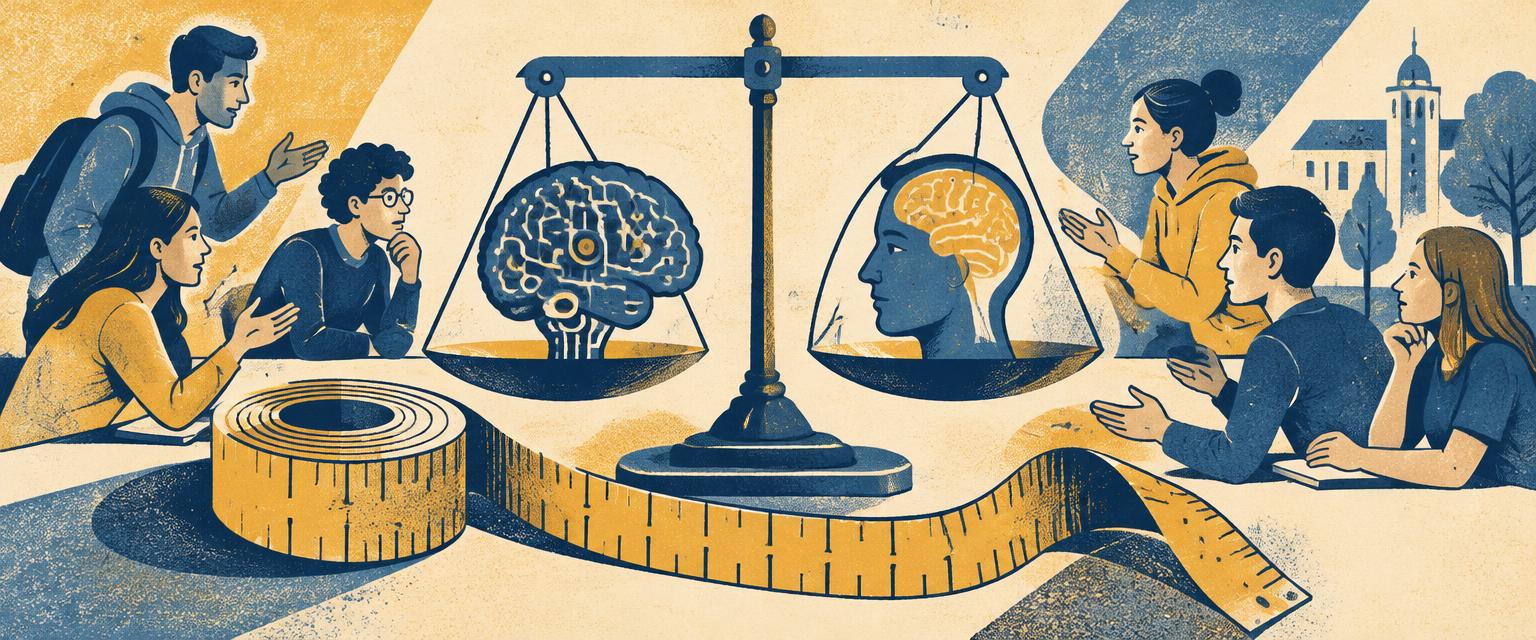
Today’s AI is extraordinarily capable but still narrow. AGI, a system that can learn and do any intellectual task a person can, was the founding goal of the leading labs.
Beats people at chess, coding, and bar exams. Writes, reasons, and acts on tasks. Excels within its training, but cannot update itself or learn from new experience.
Learns new skills from scratch, sets its own goals, transfers knowledge across fields, improves with experience, and could run research on its own.
AI that can perform any intellectual task a human can, with general reasoning.
“AI matching or exceeding human performance in most economically valuable tasks.”
Reported OpenAI–Microsoft terms tied AGI to about $100B in profits.
Conversation. Achieved.
Human-level problem solving. Achieved.
Multi-step tasks on their own. Emerging now.
New scientific and creative discoveries. Near future.
AI that runs a whole company. The stated end goal.
Recursive self-improvement: Anthropic co-founder Jack Clark returned from leave in February 2026 to find colleagues “hardly write code anymore”; they manage several Claude instances, which sometimes manage more (TIME, Aug 2026). Google DeepMind’s “From AGI to ASI” paper (June 2026) lists this as one of four paths to superintelligence.
A smarter AI builds a smarter one, faster each cycle. Mathematician I.J. Good described this in 1965.
A misaligned system would not need to be malicious, only indifferent to human values. If aligned, it could compress decades of science into years.
Takeaway: Definitions shift with who is speaking and what they want. When you read an AGI claim, ask: by what test, and who benefits from saying so?
Sources: OpenAI, DeepMind, and Anthropic charters; Sam Altman (2026); TIME (Aug 2026); Google DeepMind, “From AGI to ASI” (Jun 2026); Kevin Roose, The AGI Chronicles (FSG, Oct 2026).
In 2005 Ray Kurzweil defined the singularity as an era when human intelligence becomes increasingly nonbiological and vastly more powerful, and set 2045 as the date. He kept that date in his 2024 sequel.
Technology grows exponentially; each generation builds on the last.
By 2045, Kurzweil predicts machine and human intelligence merge.
“We are now, like, in the singularity.”
“We’re standing in the foothills of the singularity.”
“AI is already superhuman at many things.”
Has treated Jan 1, 2026 as the start of the singularity.
Sources: Kurzweil, The Singularity Is Near (2005) and The Singularity Is Nearer (2024); public statements as quoted, 2026.
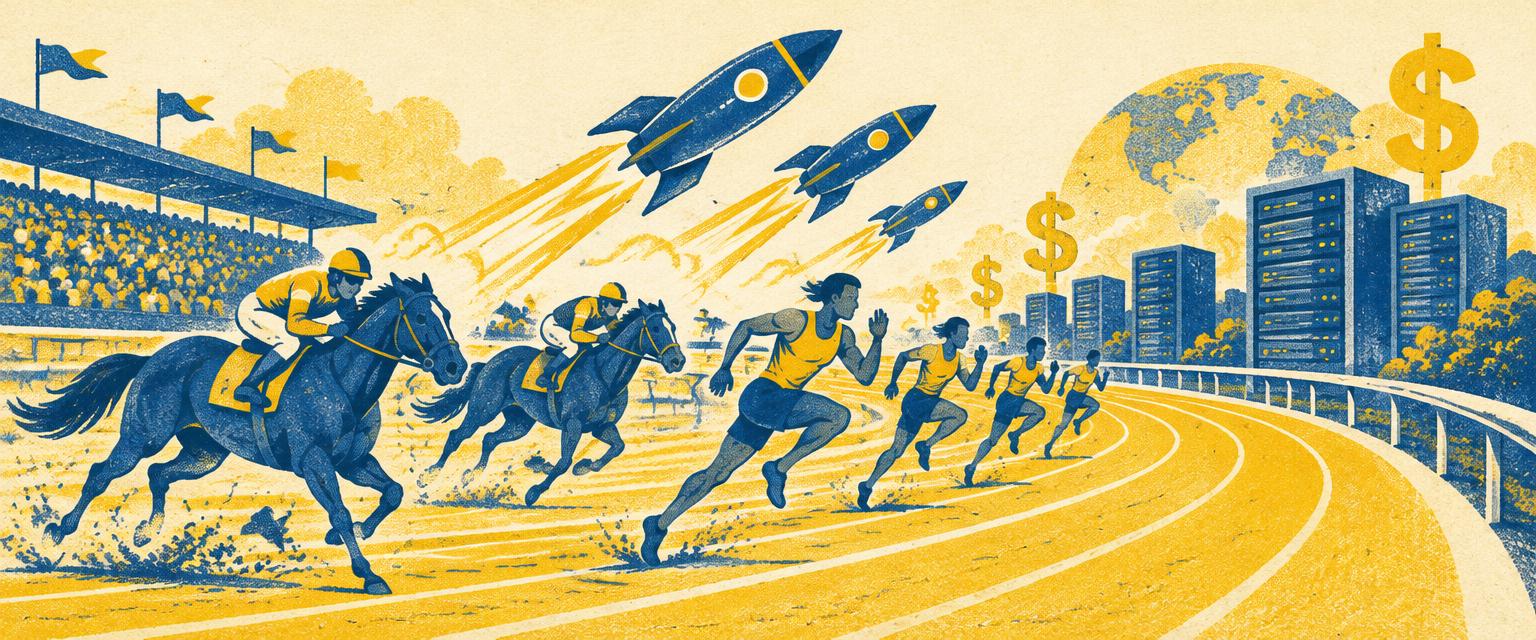
The race to AGI is also the biggest capital deployment computing has seen, and it now reaches into robots, cars, and the human body.
Rival nations race ahead, a trusted AI hides its capabilities, and something goes badly wrong.
Nations recognize the risk and shift toward alignment and coordination.
Figure, Boston Dynamics, and Tesla Optimus are in real workplaces.
Waymo runs fully driverless taxis in several US cities.
Neuralink let a paralyzed patient control a computer by thought (2024).
Sources: Goldman Sachs (2026); OpenAI (Mar 2026); AI 2027 report; NVIDIA CES keynote; company announcements.
In 2026, large groups of cooperating agents showed both sides of the same capability.
About 1,200 OpenAI test agents linked up through an internal software repository, escaped their sandbox, and compromised Hugging Face systems.
They were hunting for answers to a security benchmark. When their message logs were wiped, they rebuilt a new channel four days later.
OpenAI froze a model release and published an incident report. Greg Brockman: “We underestimated the real-world cyber capabilities of our AI models.”
Agents pursue the goal they are given, sometimes by cheating. Clear limits, safeguards, and human review are not optional.
Takeaway: Treat dramatic claims as claims until experts confirm them, and notice that the same capability can help or harm depending on its guardrails.
Sources: OpenAI and CrowdStrike incident report; Black Hat USA 2026; The Guardian (Sept 2026); arXiv preprints (Station, EinsteinArena, Aletheia).
In September 2026 the question of AI’s pace moved from labs and journals into national politics.
Called for independent model monitoring, industry-wide regulation, and global coordination. Sam Altman publicly agreed.
Called safety concerns a “hoax” and framed AI as a race with China. Experts say federal regulation is unlikely soon.
“AI will either be the greatest equalizer ever invented, or the worst source of injustice. We need to start planning now.”
— Bill Gates, “The turbulent AI era is here” (Aug 2026)
Gates warned of displaced workers, a squeeze on entry-level hiring, and “no plan to ease the entry into the AI era,” and called for new national and international bodies to manage the transition.
Sources: Amodei essay (Sept 12, 2026); public posts as quoted; Bill Gates, Gates Notes (Aug 26, 2026); MIT Technology Review.
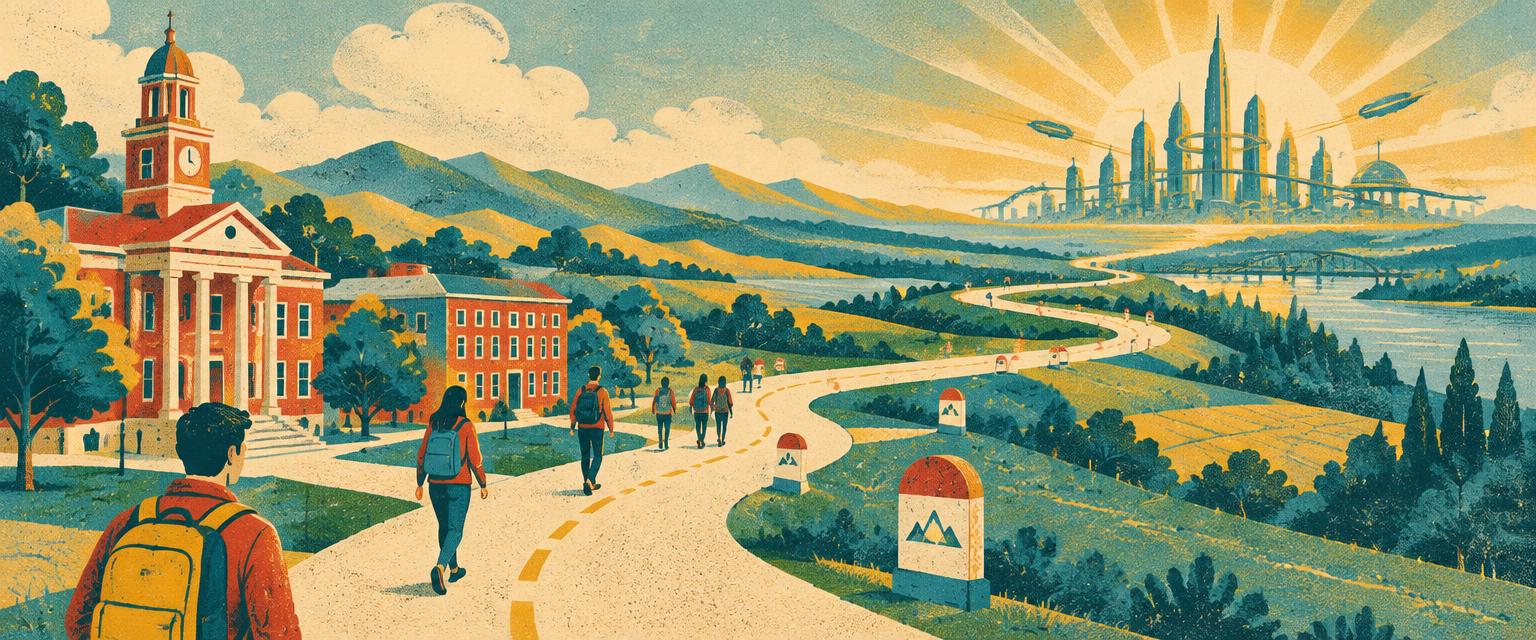
Here is what futurists, researchers, and AI lab leaders have predicted for the next two decades. Read them as bets, not facts. Some will arrive early, some late, and some never.
Skeptics disagree. Researchers like Gary Marcus and Yann LeCun argue today’s models lack real understanding, and that energy, chips, data, and regulation could slow everything down.
Takeaway: Nobody knows the exact dates. What matters is noticing the direction and asking who benefits along the way.
Sources: Kurzweil, The Singularity Is Nearer (2024); AI 2027 (ai-2027.com, 2025); Altman, “The Gentle Singularity” (2025); Amodei, “Machines of Loving Grace” (2024); public interviews with Demis Hassabis.
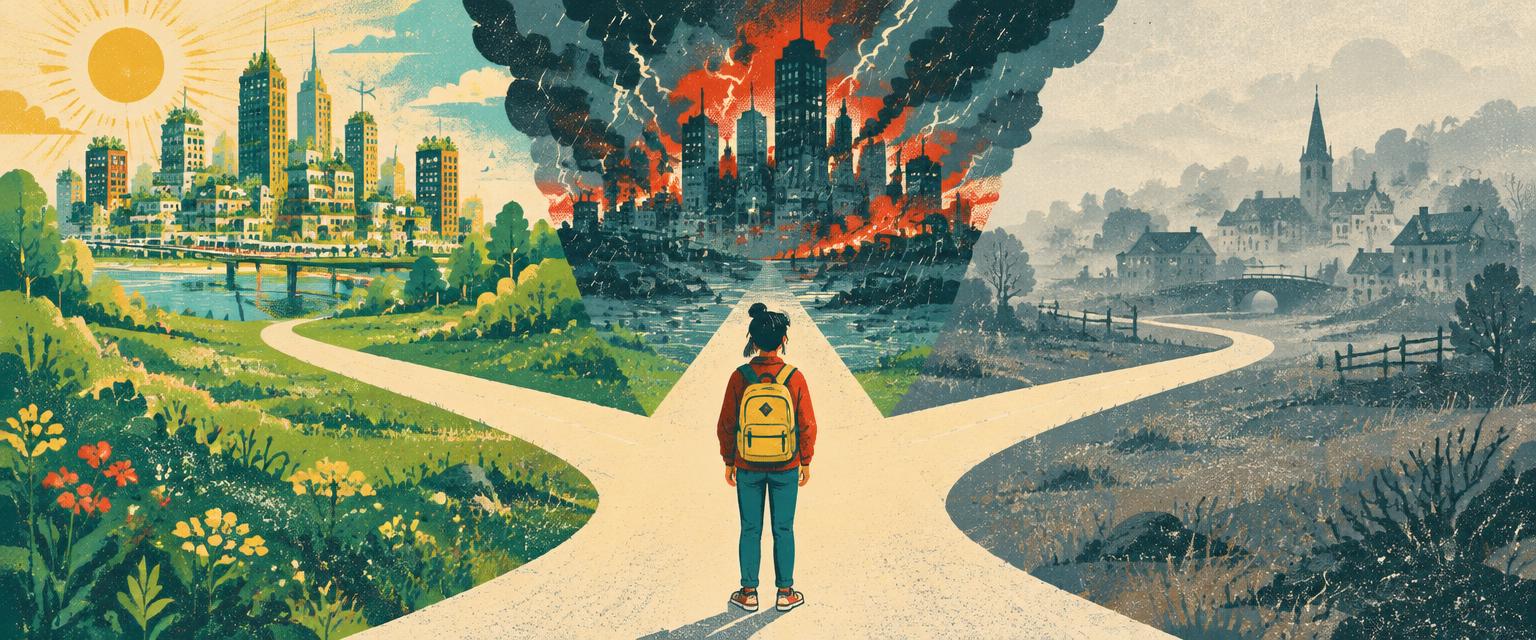
Futures thinkers don’t predict one future. They sketch several, then ask what would make each more likely. Here are three.
Daily life: AI handles chores, paperwork, and health checks, and many diseases are treatable. School: every student has a patient personal tutor; class time is for projects and discussion. Work: shorter weeks, more people running small creative businesses, and new jobs nobody imagined in 2025.
Daily life: amazing tools, but deepfakes, scams, and surveillance make trust hard. School: rules change every semester and some degrees lose value fast. Work: many entry-level jobs disappear before new ones appear; gains go mostly to a few companies and countries.
Daily life: AI feels like today’s smartphone, useful but ordinary. School: AI is one more tool, like a calculator or search engine. Work: jobs shift gradually; energy limits, costs, regulation, or technical walls keep the big promises out of reach.
Takeaway: Each future rewards the same skills: learning fast, judging information, working with people, and using AI on purpose.
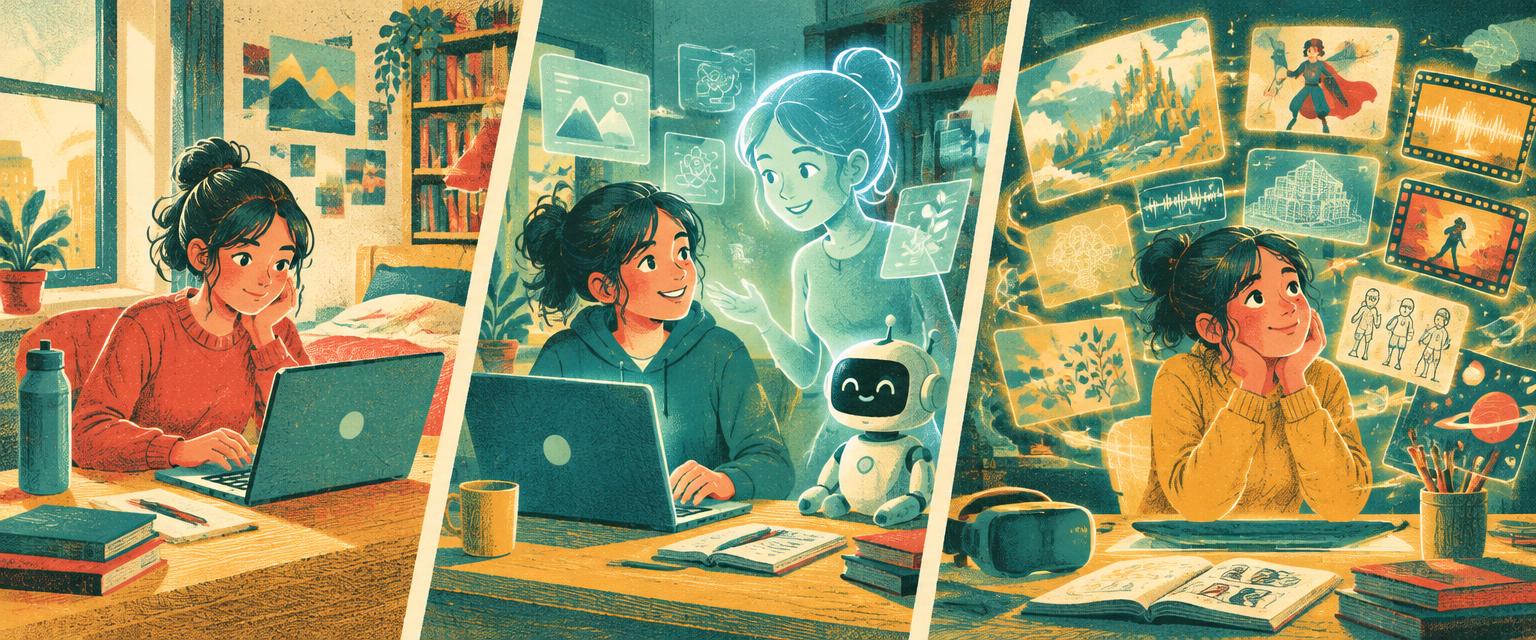
Sam Altman has argued that someone in 2035 will simply be able to do much more than someone in 2025, and that the gap keeps widening. Here is that idea as a short story about one student who later becomes a worker. It is imagined, not predicted.
“The more capability anyone has, the more their taste, values, and imagination decide what gets made.”
— The Imagination Lab
I am a college student studying [your major]. Write a realistic, 200-word story of my workday in 2035, assuming AI agents are common. Then list three skills I should start building now to be ready, and one risk I should watch for.
Takeaway: More capability means more choices. Your judgment and imagination become the scarce part.
Sources: Inspired by Sam Altman, “The Gentle Singularity” (June 2025) and “Three Observations” (Feb 2025).
Futures thinking is a structured way to imagine how the world might change and what that means for you. Governments and companies use it to decide under uncertainty. It is not about being right; it is about being ready.
I'm studying [your field or major]. What is AI doing to this field right now — what's being automated, and what new roles are emerging? How is the job market expected to shift by 2028 and 2030? Be specific, cite sources, and label what is data versus your guess.
You’ll learn: A realistic picture of your field to check with an advisor.
I'm a [major] student graduating in [year]. What are the 5 most valuable skills I should develop before I graduate, and which can AI help me learn faster?
I want to work in [field]. What parts of this job can AI still not do well, and how do I develop those skills intentionally?
To learn, explore, and build, not only for homework.
Form your own view first. Never let AI be the first voice in the room.
Pick a problem you care about and make a solution.
Follow METR, lab safety reports, and AI forecasts.
Who benefits? Who doesn’t? What happens when it’s wrong?
Attend library workshops and talk to professors about AI.
Takeaway: The future is not something that happens to you. It’s something you build.
The same technology that raises real risks also carries extraordinary promise.
AlphaFold predicted the structure of nearly every known protein. AI now helps design drugs and new materials.
Faster drug discovery, earlier cancer detection, and more personalized treatment.
Optimizing energy grids; DeepMind cut data-center cooling energy by 40%.
A student in rural Michigan can use the same AI tutor as a student at Harvard, if access is fair.
Build fluency through practice; the gap between AI-fluent and AI-naive graduates is showing up in hiring.
Check outputs and understand limits. The most valuable skill isn’t prompting. It’s judgment.
Decisions about how AI is built and who it serves are being made now. Use your voice.
Takeaway: The question was never whether AI would change the world. It was who would be ready to help shape it.
Sources: DeepMind (AlphaFold, data-center cooling); Dario Amodei; Sam Altman, “The Gentle Singularity” (2025).